
Action Policies
An action policy tells StorONE that a particular kind of operation needs the approval of several administrators before it runs. This page covers creating, editing, listing, and deleting policies. For the big picture, see Multi-Admin Approval; for a complete, recommended setup, see Deploying Multi-Admin Approval; and for what happens after a policy is triggered, see Pending Actions.
What an action policy governs
An action policy is defined by two things: an entity type (what kind of thing it governs) and an operation type (what kind of change to that thing it governs). Only specific combinations are supported:
| Entity type | Operation | What needs approval |
|---|---|---|
| Volume | Delete | Deleting a volume. |
| Snapshot scheduler | Edit | Changing a snapshot schedule. Also makes scheduled snapshots immutable. |
| Action Policy | Create, Edit, Delete | Changing the approval policies themselves. |
A policy is named after its entity type and operation, for example Volume Delete or Snapshot scheduler Edit. You can only have one action policy per combination.
Once a policy exists, any user who triggers the governed operation — for example, a ReadWrite user running applications volumes delete on a volume — no longer performs it directly. StorONE instead creates a pending action and leaves the operation un-applied until the policy's approval requirements are met. If an approved volume delete happens on a system that has a recycle bin configured, the volume is moved to the recycle bin rather than being deleted outright — see Recycle Bin.
Creating, editing, or deleting action policies — and approving or declining pending actions — requires the Admin role in your organization, and only Admin users can be named as reviewers. Any user can still see and cancel the pending actions they personally triggered; see Pending Actions.
Creating an action policy
Using the web interface
- Open Administration > Action Policies.
- Click Create.
- Fill in:
- Entity Type — the kind of thing to govern: Volume, Snapshot scheduler, or Action Policy.
- Operation Type — the operation on that entity type to govern. The choices offered depend on the entity type you picked (for example, Volume only offers Delete).
- Authorized Reviewers — the Admin usernames allowed to approve or decline pending actions created by this policy. Only Admin users are offered. Must include at least as many usernames as Minimum Required Reviewers.
- Minimum Required Reviewers — how many of the authorized reviewers must approve before the action is carried out. Minimum of 2, and no more than the number of reviewers you selected.
- Click Submit to create the policy.
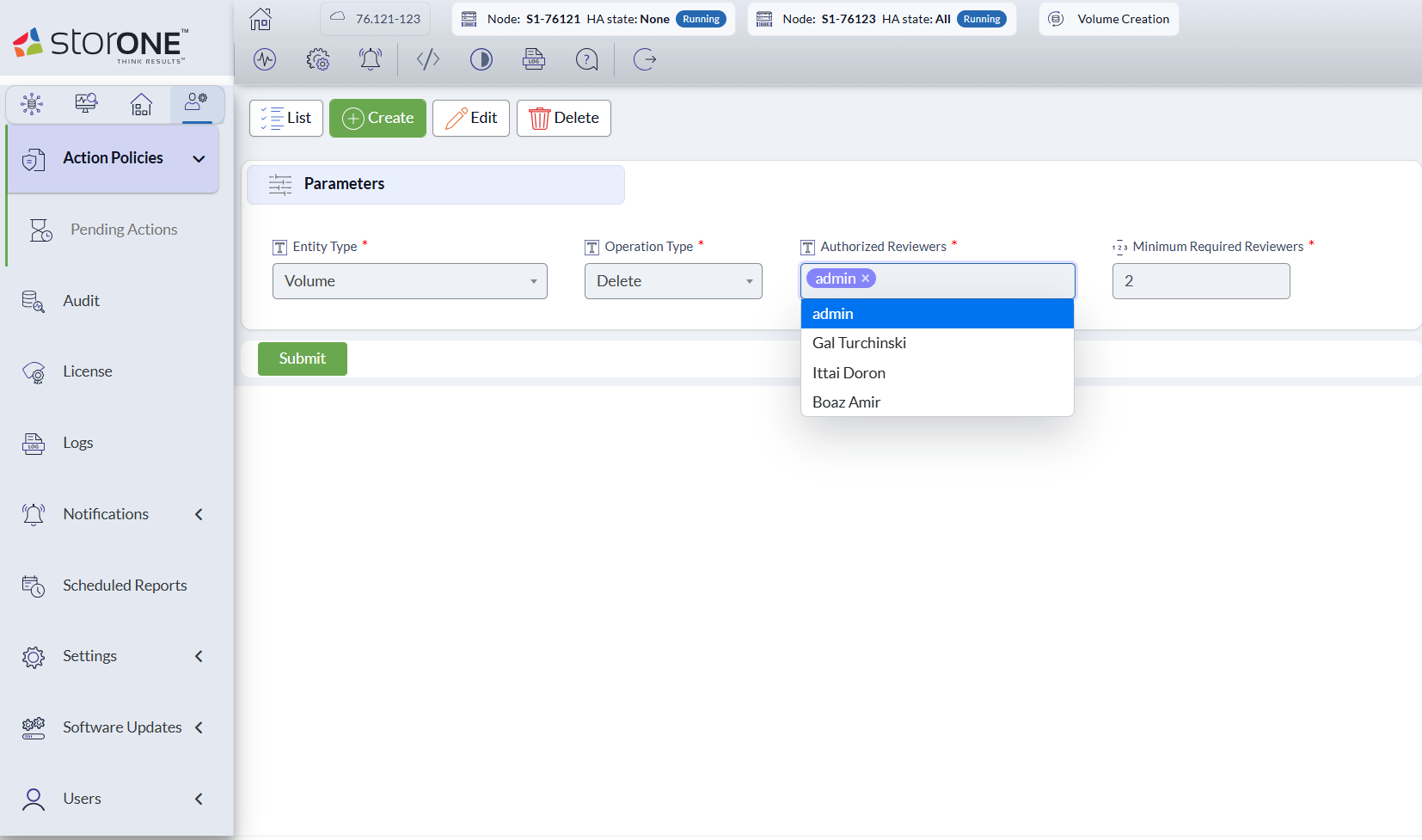
Creating a Volume Delete policy: Entity Type is Volume, Operation Type is Delete, the Authorized Reviewers list offers Admin accounts, and Minimum Required Reviewers is 2.
Using the CLI
action_policies create --entityType=<name> --operationType=<name> --authorizedReviewers=<name...> --minimumRequiredReviewers=<numbers>
| Option | Description |
|---|---|
--entityType=<name> |
The entity type this action policy applies to (Volume, Snapshot scheduler, or Action Policy). |
--operationType=<name> |
The operation type this action policy applies to. Must be an operation type enforced for the chosen entity type. |
--authorizedReviewers=<name...> |
Usernames of the admins authorized to review this policy's pending actions. Must include at least --minimumRequiredReviewers admins. |
--minimumRequiredReviewers=<numbers> |
The minimum number of admin approvals required (at least 2). |
Examples
Require two of three specific admins to approve any volume deletion:
action_policies create --entityType Volume --operationType Delete --authorizedReviewers alice bob carol --minimumRequiredReviewers 2
Require both admins to approve any change to a snapshot schedule, and make scheduled snapshots immutable:
action_policies create --entityType "Snapshot scheduler" --operationType Edit --authorizedReviewers alice bob --minimumRequiredReviewers 2
Editing an action policy
You can change who the authorized reviewers are and how many approvals are required. The entity type and operation type an existing policy governs can't be changed — delete the policy and create a new one instead.
Using the web interface
- Open Administration > Action Policies.
- Select the policy and click Edit.
- Update Authorized Reviewers and/or Minimum Required Reviewers.
- Confirm the change.
Using the CLI
action_policies edit <name> --authorizedReviewers=<name...> --minimumRequiredReviewers=<numbers>
| Option | Description |
|---|---|
<name> |
The name of the action policy to edit — this is the entity type and operation type together, e.g. Volume Delete (the names appear in the output of action_policies list, described below). |
--authorizedReviewers=<name...> |
Usernames of the admins authorized to review this policy's pending actions. Must include at least --minimumRequiredReviewers admins. |
--minimumRequiredReviewers=<numbers> |
The minimum number of admin approvals required (at least 2). |
Example — add a third reviewer and require any two of the three to approve:
action_policies edit "Volume Delete" --authorizedReviewers alice bob carol --minimumRequiredReviewers 2
Listing action policies
Using the web interface
Open Administration > Action Policies and click List. Filter by Name or Entity Type, click Submit, and select a policy to see its details: entity type, operation type, minimum required reviewers, and authorized reviewers.
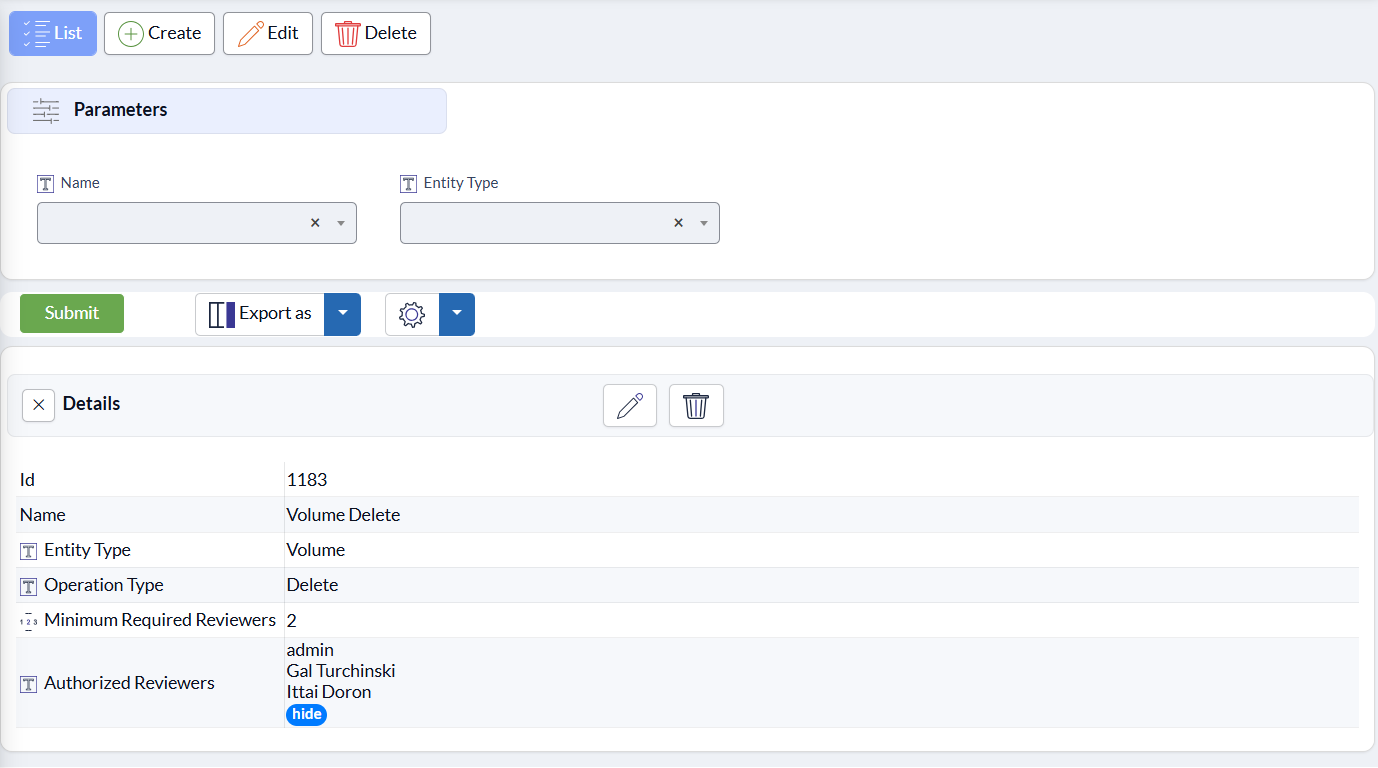
The details of a Volume Delete policy. The pencil and trash icons in the Details header edit or delete it.
Using the CLI
action_policies list [<name>] [--entityType=<name>] [--operationType=<name>]
| Option | Description |
|---|---|
<name> |
Filter action policies by name (<EntityType> <OperationType>, e.g. Volume Delete). |
--entityType=<name> |
Filter by entity type. |
--operationType=<name> |
Filter by operation type. |
Examples
List every configured action policy:
action_policies list
List only policies governing volume deletion:
action_policies list --entityType Volume --operationType Delete
Deleting an action policy
You can't delete an action policy while it has a pending action associated with it — resolve (approve/decline, then let it complete or get cancelled) or delete that pending action first. See Pending Actions. If you have an Action Policy Delete policy, deleting a policy is itself a pending action that needs approval.
Using the web interface
- Open Administration > Action Policies.
- Select the policy and click Delete.
- Confirm the deletion.
Using the CLI
action_policies delete <name>
| Option | Description |
|---|---|
<name> |
The name of the action policy to delete (<EntityType> <OperationType>, e.g. Volume Delete). |
Example
action_policies delete "Snapshot scheduler Edit"
Using the REST API
Action policies are managed with these endpoints. The Action policies endpoint reference lists every parameter.
| Operation | Request |
|---|---|
| Create a policy | POST /action_policies/create |
| Edit a policy | PUT /action_policies/edit?name=<policy name> |
| Delete a policy | DELETE /action_policies/delete?name=<policy name> |
| List policies | GET /action_policies/list |
As with the CLI, creating, editing, and deleting policies requires an Admin user. For example, to require two of three admins to approve any volume deletion:
POST /action_policies/create
Content-Type: application/json
Authorization: Bearer <SessionToken>

{
  "EntityType": "Volume",
  "OperationType": "Delete",
  "AuthorizedReviewers": ["alice", "bob", "carol"],
  "MinimumRequiredReviewers": 2
}
The policy name for edit and delete is the entity type and operation together, such as Volume Delete (URL-encoded: name=Volume%20Delete). See Authentication for how to get a session token.
Next: Pending Actions — reviewing, approving, declining, and cancelling the actions an action policy holds for review. See also: Best practices · Troubleshooting
No comments to display
No comments to display