
Object Store High Availability
An object store's endpoint is a floating IP shared by both nodes of the HA pair. Clients always connect to the same address, whichever node is serving the store.
How failover works
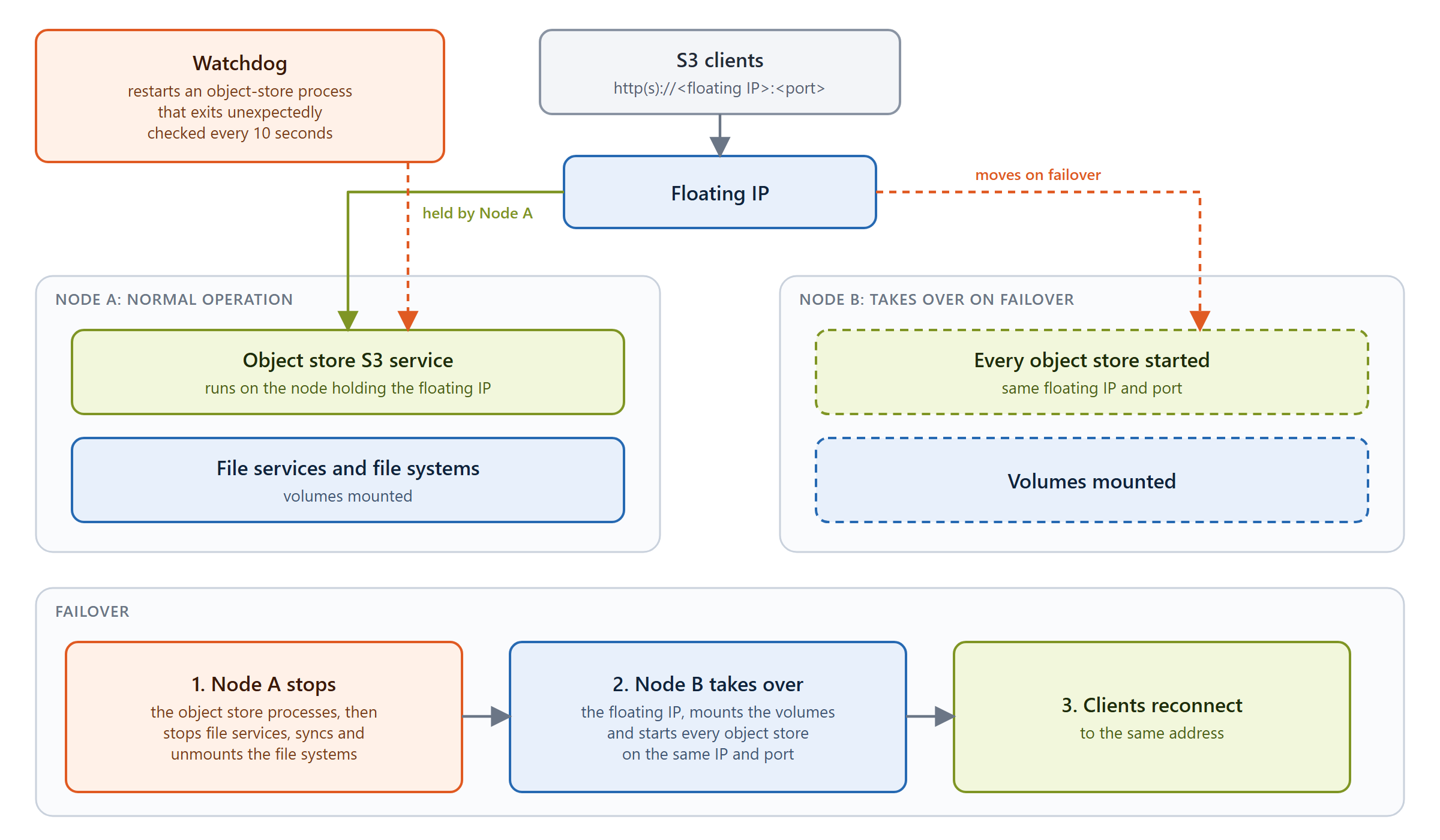
Object stores run on the node that currently runs the system's file services. When that role moves to the partner node:
- The node giving up the role stops its object store processes, then stops its file services, and syncs and unmounts the file systems.
- The partner node takes over the floating IP, mounts the volumes and starts every object store on the same IP address and port.
- Clients reconnect to the same endpoint. S3 clients and SDKs normally retry failed requests on their own, but check the retry settings of applications that write critical data.
Automatic recovery
- Process watchdog. If an object store process exits unexpectedly, the system starts it again. It checks every 10 seconds.
- Consistency group availability. If a store's consistency group becomes unavailable, the store stops. It starts again automatically when the consistency group is available.
- Floating IP changes. If you change the address of a floating IP, every store that uses it restarts on the new address.
What interrupts clients
| Change | Effect on connected clients |
|---|---|
| Adding, editing or removing access keys | None: the store reloads its credentials without restarting. |
| Adding stripes, growing a volume | None. |
| Changing the store's port, floating IP, HTTPS or IAM settings | Brief reconnect: the store's S3 service restarts. |
| Node failover | Brief reconnect: the store moves to the partner node. |
Plan restarting changes for a quiet period, or make sure the applications using the store retry.
Next: Monitoring object stores