
Object Lock (WORM)
Object Lock stores object versions in WORM (write-once-read-many) form: a locked version can't be overwritten or deleted until its retain-until date. Typical uses are immutable backup repositories (ransomware protection), record retention and audit logs.
Object Lock is set up per bucket and per object through the S3 API, by an Admin access key or an IAM user whose policy allows it. It builds on versioning, so read that page first.
Turning on Object Lock
- Object Lock is turned on when the bucket is created (
--object-lock-enabled-for-bucket). It can't be added to an existing bucket. - Creating an Object Lock bucket turns versioning on automatically, and it can't be suspended on that bucket.
- Object Lock can't be turned off on a bucket once it's on.
- Retention is set per object version, in either of two ways:
- Default bucket retention: a mode plus a period in days or years (
put-object-lock-configuration). It's applied automatically to every new version written to the bucket. - Explicit per-version retention: a mode plus a retain-until date, given at upload (
--object-lock-mode,--object-lock-retain-until-date) or later (put-object-retention). It overrides the bucket default for that version.
- Default bucket retention: a mode plus a period in days or years (
The two retention modes
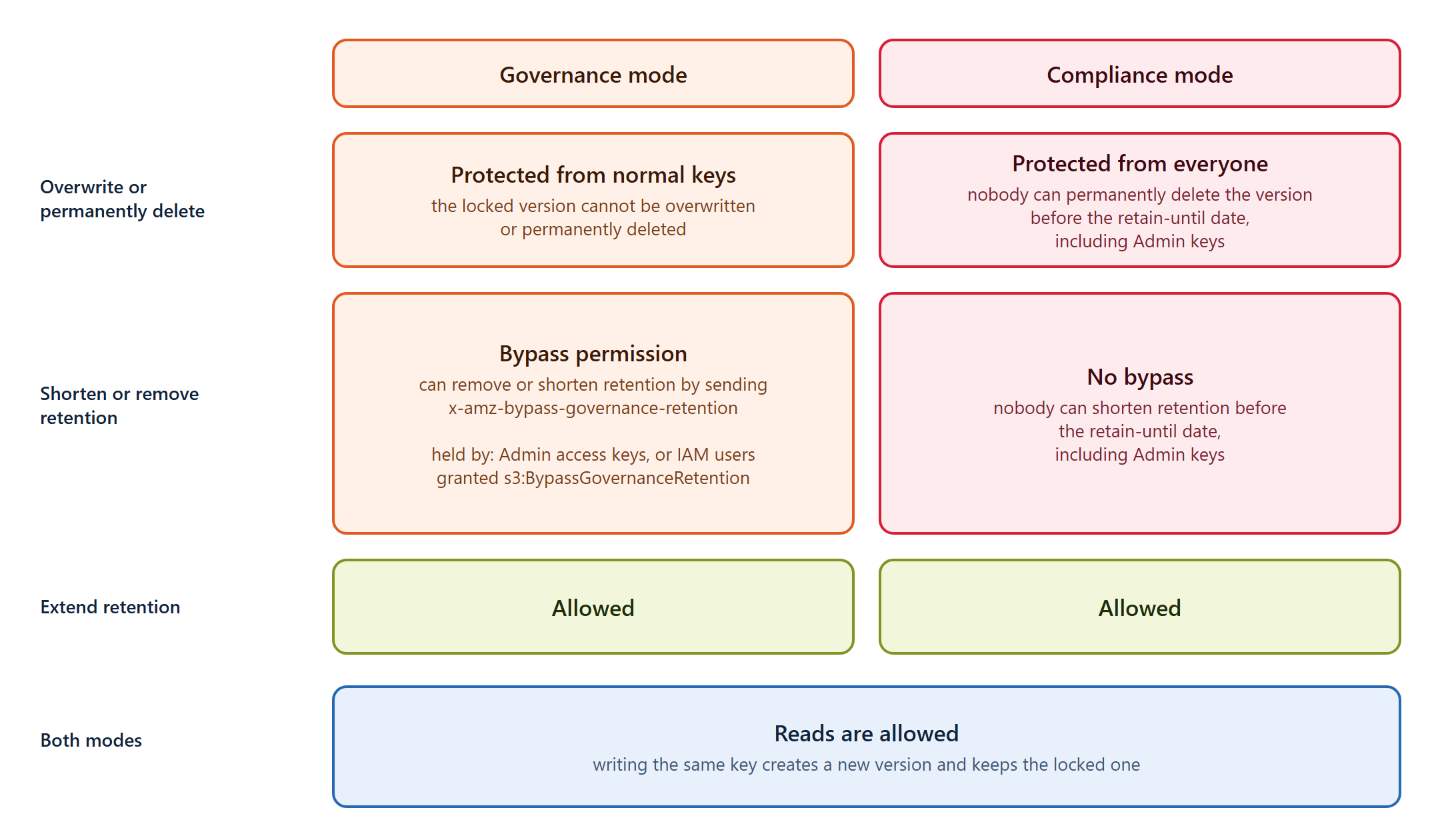
| Governance mode | Compliance mode | |
|---|---|---|
| Purpose | Protection against accidental or unauthorised deletion, with an administrative override. | Strict immutability. |
| Overwrite or delete the locked version | Blocked for normal users. | Blocked for everyone, including Admin access keys. |
| Bypass | Allowed for Admin access keys, and IAM users granted s3:BypassGovernanceRetention, when they send x-amz-bypass-governance-retention: true. |
No bypass exists. |
| Shorten or remove retention | Only with bypass. | Never. |
| Extend retention | Allowed. | Allowed. |
| Change mode | Can be upgraded to Compliance. | Can't be changed to Governance. |
| Protection ends | At the retain-until date, or earlier through a privileged bypass. | Only at the retain-until date. |
| Typical use | Testing retention policies; operational protection; data that may need early removal. | Immutable backups and records that must not be removable before their date. |
Choose carefully. A version written in Compliance mode, or into a bucket whose default retention is Compliance, can't be deleted through S3, and its capacity can't be reclaimed, until the retention date. Test with Governance mode first, then switch the bucket default to Compliance.
What Object Lock blocks
| Action | Locked version (Governance) | Locked version (Compliance) |
|---|---|---|
| Read (GET / HEAD) the version | Allowed | Allowed |
| PUT the same key (creates a new version) | Allowed; the locked version is kept | Allowed; the locked version is kept |
| DELETE without a version ID (adds a delete marker) | Allowed; the locked version is kept | Allowed; the locked version is kept |
| DELETE with a version ID (permanent) | Denied, unless bypassed by a privileged key | Denied |
| Shorten or remove the retention | Denied, unless bypassed | Denied |
| Extend the retention | Allowed | Allowed |
| Delete the bucket | Denied while it holds versions | Denied while it holds versions |
Object Lock protects versions, not key names. A plain DELETE still hides the object behind a delete marker, but the locked data stays intact and can be recovered by removing the marker (see Object versioning).
Who can do what
| Capability | Admin key | Regular key | IAM user |
|---|---|---|---|
| Create an Object Lock bucket | Yes | No | Per policy |
| Set the bucket's default retention | Yes | No | Per policy |
| Write objects with retention | Yes | Yes | Per policy |
| Extend retention | Yes | Yes | Per policy |
| Bypass Governance | Yes | No | If granted s3:BypassGovernanceRetention |
| Bypass Compliance | No | No | No |
Object Lock and the rest of StorONE
- Snapshots add a second layer. StorONE snapshots of the store's volumes are independent of S3. The whole store can be restored from them into a new store.
- Protect the management side too. Object Lock is enforced on the S3 side. Deleting the store's volumes is a StorONE administration operation, outside the S3 API. See Object storage security.
- Size for retention. Locked versions hold their capacity until their date: size the store for retention period × change rate, plus the full backups (see Capacity planning).
Setting up an immutable backup repository
- Deploy a store with an Admin key for the backup administrator. Give the backup application a Regular key, or an IAM user with write and retention permissions only.
- Create the repository bucket with Object Lock.
- Check the setup with a short Governance default retention (for example 1 day), then switch the default to Compliance with the period you need. Alternatively, let a backup application with S3 immutability support set per-object retention itself.
- Keep StorONE snapshots of the store's volumes as a second, independent recovery layer.
Examples
EP="--endpoint-url https://10.0.0.50:9000 --no-verify-ssl"

# Create a bucket with Object Lock (versioning is turned on automatically)
aws $EP s3api create-bucket --bucket immutable-backups --object-lock-enabled-for-bucket

# Default retention: Compliance, 30 days, for every new object version
aws $EP s3api put-object-lock-configuration --bucket immutable-backups \
    --object-lock-configuration '{"ObjectLockEnabled":"Enabled","Rule":{"DefaultRetention":{"Mode":"COMPLIANCE","Days":30}}}'
aws $EP s3api get-object-lock-configuration --bucket immutable-backups

# Upload with explicit Governance retention
aws $EP s3api put-object --bucket immutable-backups --key job-0412.vbk --body job-0412.vbk \
    --object-lock-mode GOVERNANCE --object-lock-retain-until-date 2027-01-01T00:00:00Z

# Inspect or extend the retention of a version
aws $EP s3api get-object-retention --bucket immutable-backups --key job-0412.vbk --version-id <id>
aws $EP s3api put-object-retention --bucket immutable-backups --key job-0412.vbk --version-id <id> \
    --retention '{"Mode":"GOVERNANCE","RetainUntilDate":"2027-06-01T00:00:00Z"}'

# Governance only: an Admin key removes a protected version early
aws $EP s3api delete-object --bucket immutable-backups --key job-0412.vbk --version-id <id> \
    --bypass-governance-retention

# Compliance: the same command is refused (AccessDenied) until the retain-until date